 Add to Chrome
 Add to Firefox
 Add to Edge
CAREAgent: Clinical Agent with Structured Reasoning and Tool-Integrated for Order Generation
May 31, 2026
Clinical order generation serves as a critical bridge between clinical decision-making and real-world practice, translating medical decisions into concrete and executable orders. Existing agents mainly focus on coarse-grained decisions and overlook the fine-grained, executable information required for clinical orders. To address this gap, we propose CAREAgent, an agent for clinical order generation. To support its training, we introduce a two-stage agentic reasoning data construction method. First, we design an agent framework that constructs verifiable reasoning trajectories aligned with realistic clinical tool usage. Second, we filter reasoning trajectories by format compliance, order validity, and clinical plausibility. Building on the constructed data, the model is first trained via supervised fine-tuning to acquire fundamental reasoning formats and medical knowledge, and is subsequently optimized through reinforcement learning with multi-dimensional reward functions to enhance complex clinical reasoning capabilities. Experiments on multiple benchmarks demonstrate the effectiveness of CAREAgent. On ClinicalBench (unseen during training), CAREAgent improves the F1 score by 5.05%, 2.09%, and 0.86% over the single-agent, multi-agent, and agentic reasoning methods, respectively.

Evolve as a Team: Collaborative Self-Evolution for LLM-based Multi-Agent Systems
May 28, 2026LLM-based multi-agent systems (MAS) have emerged as an effective paradigm for complex and long-horizon tasks. However, in real-world tasks, MAS often exhibit various failures during execution and such failures are difficult to eliminate during design. This motivates experience-driven MAS evolution, where a system improves based on its own execution experience. Yet such evolution is challenging because MAS experience is prolonged and intricate, interleaving multiple agents' execution chains and communication messages, which makes it difficult to identify what should be improved. To address this challenge, we propose Meta-Team, an experience-driven MAS evolution framework based on collaborative self-evolution. Meta-Team preserves the execution context of each agent and coordinates post-task communication, enabling agents to exchange distributed evidence for evolution. Building on this design, Meta-Team conducts multi-scale self-evolution, transforming execution experience into reusable improvements to agent behaviors, inter-agent coordination, and team-level organization. Across six long-horizon agent benchmarks, Meta-Team consistently outperforms single-agent systems, hand-crafted MAS, and prior MAS evolution methods; further analyses demonstrate that Meta-Team enables more reliable and scalable MAS self-evolution.
Meta-Cognitive Memory Policy Optimization for Long-Horizon LLM Agents
May 28, 2026Memory-augmented LLM agents tackle complex long-horizon tasks by recursively summarizing interaction trajectories into compact memory. However, existing approaches typically train these memory policies using outcome-based reinforcement learning, failing to localize where intermediate memory quality degrades. As interactions unfold, ambiguous recursive summaries progressively discard task-relevant information and introduce semantic noise. This exacerbates belief deviation, obscuring the agent's estimate of the latent task state and ultimately derailing long-horizon reasoning. We therefore argue that memory optimization should focus not merely on trajectory-level success, but on the clarity of the belief induced by intermediate summaries. To this end, we introduce Belief Entropy, a self-supervised proxy that probes how uncertain the model remains about the latent task state given its current memory. Based on this proxy, we propose Metacognitive Memory Policy Optimization (MMPO). Instead of relying only on sparse outcome-based signals, MMPO provides fine-grained, memory-specific supervision via explicitly penalizing summaries that induce high epistemic uncertainty. Experiments show that MMPO consistently outperforms existing methods on diverse long-horizon tasks, maintaining 97.1% performance even when scaled to 1.75M-token contexts.
ArborKV: Structure-Aware KV Cache Management for Scaling Tree-based LLM Reasoning
May 21, 2026Recent progress in LLM reasoning has increasingly shifted from single-pass generation to explicit search over intermediate reasoning states. Tree-of-Thoughts (ToT) organizes inference to tree-structured search with branching and backtracking, but it substantially amplifies the Key--Value (KV) cache: retaining KV states for a frontier of partial trajectories quickly becomes a memory bottleneck that limits throughput and constrains search depth and width under fixed hardware budgets. We address this challenge by observing that KV reuse in ToT-style inference is governed by search dynamics: near-term decoding depends primarily on the active branch and its ancestors, whereas inactive subtrees have low short-term reuse probability yet must remain recoverable for backtracking. Motivated by this, we propose ArborKV, a structure-aware eviction framework that couples a lightweight value estimator with a tree-aware allocation policy, and performs purely token-extractive eviction with lazy rehydration to support revisits. Experiments on ToT-style reasoning benchmarks show that ArborKV achieves up to ~4x peak KV-memory reduction while preserving near-full-retention accuracy, enabling larger search configurations under fixed device budgets that would otherwise run out of memory.
SLQ: Bridging Modalities via Shared Latent Queries for Retrieval with Frozen MLLMs
Apr 16, 2026Multimodal Large Language Models (MLLMs) exhibit strong reasoning and world knowledge, yet adapting them for retrieval remains challenging. Existing approaches rely on invasive parameter updates, such as full fine-tuning and LoRA, which may disrupt the pre-trained semantic space and impair the structured knowledge essential for reasoning. In this work, we argue that adapting MLLMs for retrieval should focus on eliciting pre-trained representations rather than overwriting them. To this end, we propose SLQ, an effective and efficient framework that adapts a frozen MLLM into a retriever through a small set of Shared Latent Queries. Appended to the end of both text and image token sequences, these queries leverage the model's native causal attention to serve as global aggregation interfaces, producing compact embeddings in a unified space while keeping the backbone unchanged. Furthermore, to better evaluate retrieval beyond superficial pattern matching, we construct KARR-Bench, a benchmark designed for knowledge-aware reasoning retrieval. Extensive experiments show that SLQ outperforms full fine-tuning and LoRA on COCO and Flickr30K, while achieving competitive performance on MMEB and yielding substantial gains on KARR-Bench. The results demonstrate that SLQ, which preserves pre-trained representations, provides an effective and efficient framework for adapting MLLMs to retrieval.
How Much Reasoning Do Retrieval-Augmented Models Add beyond LLMs? A Benchmarking Framework for Multi-Hop Inference over Hybrid Knowledge
Feb 10, 2026Large language models (LLMs) continue to struggle with knowledge-intensive questions that require up-to-date information and multi-hop reasoning. Augmenting LLMs with hybrid external knowledge, such as unstructured text and structured knowledge graphs, offers a promising alternative to costly continual pretraining. As such, reliable evaluation of their retrieval and reasoning capabilities becomes critical. However, many existing benchmarks increasingly overlap with LLM pretraining data, which means answers or supporting knowledge may already be encoded in model parameters, making it difficult to distinguish genuine retrieval and reasoning from parametric recall. We introduce HybridRAG-Bench, a framework for constructing benchmarks to evaluate retrieval-intensive, multi-hop reasoning over hybrid knowledge. HybridRAG-Bench automatically couples unstructured text and structured knowledge graph representations derived from recent scientific literature on arXiv, and generates knowledge-intensive question-answer pairs grounded in explicit reasoning paths. The framework supports flexible domain and time-frame selection, enabling contamination-aware and customizable evaluation as models and knowledge evolve. Experiments across three domains (artificial intelligence, governance and policy, and bioinformatics) demonstrate that HybridRAG-Bench rewards genuine retrieval and reasoning rather than parametric recall, offering a principled testbed for evaluating hybrid knowledge-augmented reasoning systems. We release our code and data at github.com/junhongmit/HybridRAG-Bench.
Learning to Reason Faithfully through Step-Level Faithfulness Maximization
Feb 03, 2026Reinforcement Learning with Verifiable Rewards (RLVR) has markedly improved the performance of Large Language Models (LLMs) on tasks requiring multi-step reasoning. However, most RLVR pipelines rely on sparse outcome-based rewards, providing little supervision over intermediate steps and thus encouraging over-confidence and spurious reasoning, which in turn increases hallucinations. To address this, we propose FaithRL, a general reinforcement learning framework that directly optimizes reasoning faithfulness. We formalize a faithfulness-maximization objective and theoretically show that optimizing it mitigates over-confidence. To instantiate this objective, we introduce a geometric reward design and a faithfulness-aware advantage modulation mechanism that assigns step-level credit by penalizing unsupported steps while preserving valid partial derivations. Across diverse backbones and benchmarks, FaithRL consistently reduces hallucination rates while maintaining (and often improving) answer correctness. Further analysis confirms that FaithRL increases step-wise reasoning faithfulness and generalizes robustly. Our code is available at https://github.com/aintdoin/FaithRL.
Driving in Spikes: An Entropy-Guided Object Detector for Spike Cameras
Nov 19, 2025Object detection in autonomous driving suffers from motion blur and saturation under fast motion and extreme lighting. Spike cameras, offer microsecond latency and ultra high dynamic range for object detection by using per pixel asynchronous integrate and fire. However, their sparse, discrete output cannot be processed by standard image-based detectors, posing a critical challenge for end to end spike stream detection. We propose EASD, an end to end spike camera detector with a dual branch design: a Temporal Based Texture plus Feature Fusion branch for global cross slice semantics, and an Entropy Selective Attention branch for object centric details. To close the data gap, we introduce DSEC Spike, the first driving oriented simulated spike detection benchmark.
Evo-1: Lightweight Vision-Language-Action Model with Preserved Semantic Alignment
Nov 06, 2025Vision-Language-Action (VLA) models have emerged as a powerful framework that unifies perception, language, and control, enabling robots to perform diverse tasks through multimodal understanding. However, current VLA models typically contain massive parameters and rely heavily on large-scale robot data pretraining, leading to high computational costs during training, as well as limited deployability for real-time inference. Moreover, most training paradigms often degrade the perceptual representations of the vision-language backbone, resulting in overfitting and poor generalization to downstream tasks. In this work, we present Evo-1, a lightweight VLA model that reduces computation and improves deployment efficiency, while maintaining strong performance without pretraining on robot data. Evo-1 builds on a native multimodal Vision-Language model (VLM), incorporating a novel cross-modulated diffusion transformer along with an optimized integration module, together forming an effective architecture. We further introduce a two-stage training paradigm that progressively aligns action with perception, preserving the representations of the VLM. Notably, with only 0.77 billion parameters, Evo-1 achieves state-of-the-art results on the Meta-World and RoboTwin suite, surpassing the previous best models by 12.4% and 6.9%, respectively, and also attains a competitive result of 94.8% on LIBERO. In real-world evaluations, Evo-1 attains a 78% success rate with high inference frequency and low memory overhead, outperforming all baseline methods. We release code, data, and model weights to facilitate future research on lightweight and efficient VLA models.
MIND: A Multi-agent Framework for Zero-shot Harmful Meme Detection
Jul 09, 2025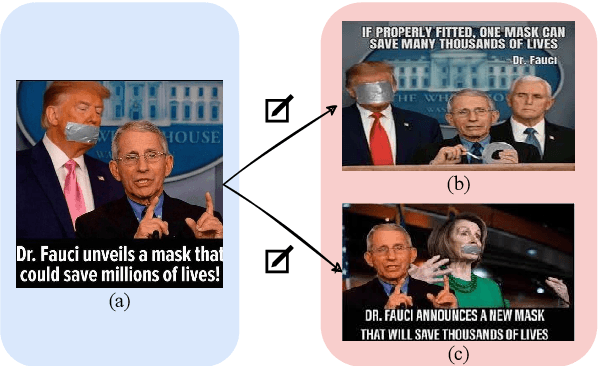
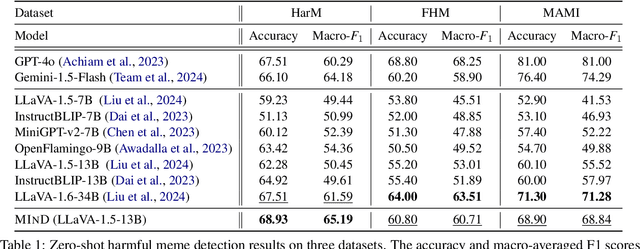
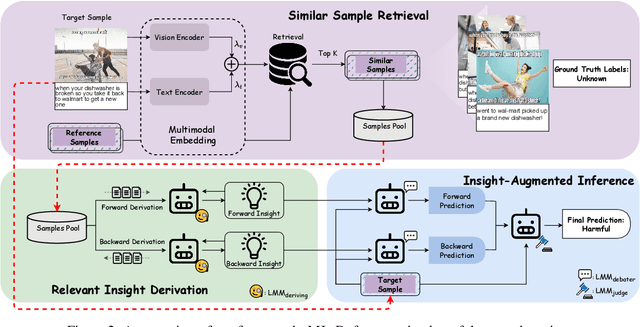
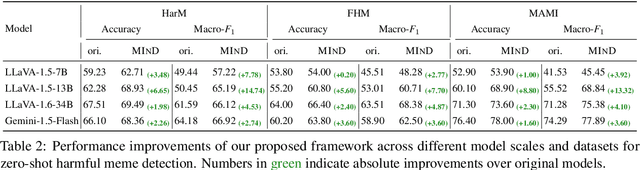
The rapid expansion of memes on social media has highlighted the urgent need for effective approaches to detect harmful content. However, traditional data-driven approaches struggle to detect new memes due to their evolving nature and the lack of up-to-date annotated data. To address this issue, we propose MIND, a multi-agent framework for zero-shot harmful meme detection that does not rely on annotated data. MIND implements three key strategies: 1) We retrieve similar memes from an unannotated reference set to provide contextual information. 2) We propose a bi-directional insight derivation mechanism to extract a comprehensive understanding of similar memes. 3) We then employ a multi-agent debate mechanism to ensure robust decision-making through reasoned arbitration. Extensive experiments on three meme datasets demonstrate that our proposed framework not only outperforms existing zero-shot approaches but also shows strong generalization across different model architectures and parameter scales, providing a scalable solution for harmful meme detection. The code is available at https://github.com/destroy-lonely/MIND.